Intellectual Statement
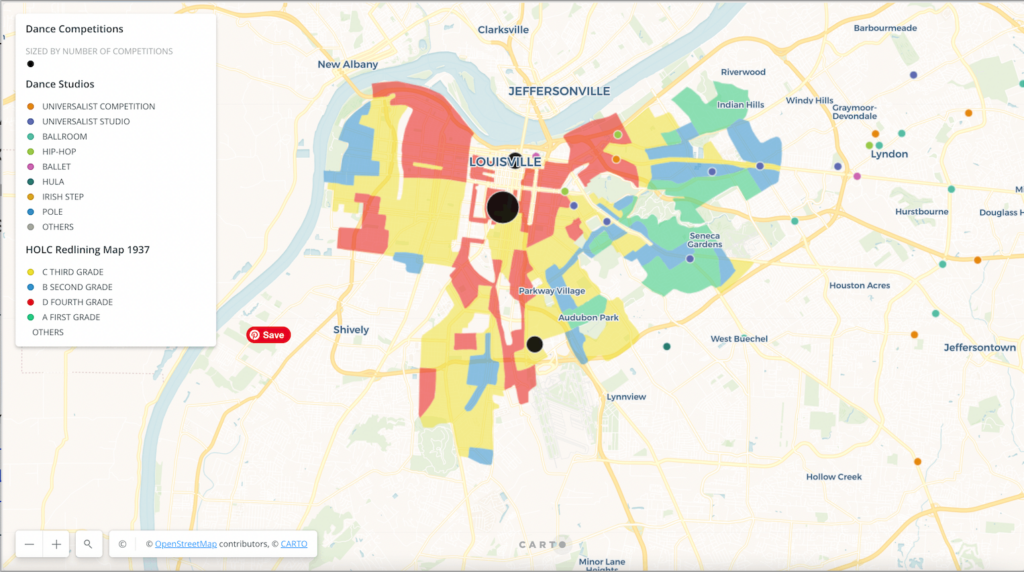
Throughout the coursework for my digital humanities certificate at UCLA, I have focused on the application of digital methods within the fields of dance and performance studies, where there is significant but limited scholarship to date (Cowan 2018; Varela 2021; Bench and Elswit 2016; 2023; 2026). In dance studies, the use of digital humanities methodologies has been focused on concert dance forms and has involved GIS mapping, social network analysis, and increasingly motion capture (Bench and Elswit 2016; 2023; 2026). My work builds on and departs from this budding research area by bringing similar methods into the space of popular dance. For example, while in the program, I constructed geographic maps that expose how enduring racial segregation in the city of Louisville, Kentucky shapes local competitive dance practices—one of the most prevalent types of formal dance training for US youth. Outside the fields of dance and performance, I brought this awareness of the body to a digital humanities group project on the connections between law enforcement agencies in Los Angeles County and surveillance technology vendors. I also increased my web design skills in the program, which I hope to use to make dance and performance research more accessible to the broader public.
My completed and future digital humanities research contributes to the growing body of datasets available within dance and performance studies for computational analysis. As mentioned above, the current scholarship at this intersection has largely used archival research on concert (often modern) dance. Emergent scholarship using motion capture likewise often focuses on modern and contemporary—read “high art”—dance forms. While the digital turn in this research has expanded the scale of questions possible for dance and performance research, it has also then replicated historical biases in the field, which overwhelmingly prioritize modern dance and ballet. My research instead brings these methods to bear on popular forms like competitive dance, while also imagining new “archives” that can be mined for the creation of datasets relevant to contemporary performance practices. Additionally, bringing these methods into dance studies contributes to an ongoing unsettling of what constitutes dance research, which has historically been tethered to the physical movements and aesthetics that occur in staged performances with less emphasis on the “behind the scenes” infrastructures that make them possible, though there are notable and growing exceptions (Schweitzer 2015; Stanger 2021; Wilbur 2021).
Similarly, in the digital humanities, my research has and will continue to join with scholars who are disrupting bias toward textual analysis and more traditional digital tools in the field (Nguyen 2025; Bench and Elswit 2026) as well as those using digital methods to challenge racist, colonial, and patriarchal dynamics within data visualization and the world more broadly (Risam 2018; Cotera 2018; D’Ignazio and Klein 2020; Nelson et al. 2023; Klein et al. 2025). A central concern within the digital humanities, and particularly projects committed to anti-racist, decolonial, and feminist research, has been the capacity for dehumanization embedded within the process of creating digital scholarship (D’Ignazio and Klein 2020; Klein et al. 2025; Bench and Elswit 2026). By centering dance and performance, I aim for my work to fundamentally challenge these subjugating possibilities, foregrounding the body even within digital realms; and to apply these techniques in the critical examination and unsettling of how white supremacy, cisheteropatriarchy, and capitalist exploitation are too often furthered when digital exploration is applied to embodiment. As I look ahead to my future research, I hope to bring GIS mapping, network analysis, and learn and incorporate motion capture, into my teaching and research to support the growth of scholarly inquiry at the intersections of dance, performance, digital humanities, and anti-racist, decolonial, and feminist praxis. Two key projects on the horizon will particularly apply the skills I have gained thus far to trace financial ties between a monopolistic dance corporation, Varsity Spirit, and far-right political actors and initiatives as well as another spatial project tracing Louisville dance histories tied to US military initiatives.
Critical Understanding
In my understanding, “digital humanities” refers to an interdisciplinary field that invites new questions for studies of human cultures by merging computational and humanistic approaches to scholarship. The field particularly enables a larger scale of analysis within humanities disciplines (Kaplan 2015; Bench and Elswit 2016), while prompting considerations of ethics and power relations embedded in technological tools and advancements (Bailey 2015; Risam 2018; D’Ignazio and Klein 2020), which are always already imbricated. While some genealogies trace the emergence of the academic field to the 1950s and consolidating in the 1970s-80s (Hockey 2004; Vanhoutte et al. 2013), others reach back to critical data visualization projects from earlier eras—like graphs created by W.E.B. Du Bois and his students or maps documenting colonial violence created by Shanawdithit (Rusert and Battle-Baptiste 2018; Klein et al. 2025). These more extended genealogies reveal the field’s potential to heed Sylvia Wynter’s call to conduct decolonial and antiracist scholarship at the intersection of the humanities and sciences rather than reifying their constructed divide (McKittrick 2015). Although like most academic fields, digital humanities scholarship and the tools that undergird its interventions have not always been employed with this decolonial and antiracist orientation, there is a significant strain of such scholarship which both exposes the operations of power within the digital humanities as a field and applies computational methods within humanist research projects to target oppressive dynamics within society more broadly (Bailey 2015; Risam 2018; Cotera 2018; D’Ignazio and Klein 2020; Nelson et al. 2023; Klein et al. 2025). It is with and through this strain of scholarship that my understanding of the field has developed and that I align my definition of the digital humanities.
With technological innovations, technical capacities in the field have grown from textual analysis, GIS mapping, and social network analysis to motion capture, visual clustering, and VR/AR/Mixed Reality interventions, among others. Additionally, due to skill gaps that often emerge as humanists take up computational methods and scientists engage the arts and humanities, I understand the field as fundamentally collaborative and experimental, inviting play, frustration, and rigor in the shared creation of new knowledge in digital forms (Tracy and Hoiem 2017; Walsh 2019). These methodological trends have resulted in projects as wide ranging as a network map that shows six degrees of separation from Kevin Bacon (Reynolds 1999), geographic maps that show colonial theft through land grant institutions (Lee et al. 2020), and pedagogical tools that allow students to virtually step into and enhance their understanding of historical sites (Chandler et al. n.d.). Ultimately, then, the digital humanities raise questions about scales of impact, trajectories of travel, networks of relationships, and the imbrications of embodiment and digital worlds, while providing the opportunity to reveal historical and contemporary injustices in critical ways.
Examples of Practical Abilities
While completing my digital humanities certificate I have gained general and practical skills in several technical areas. I have most extensively worked with geospatial platforms and tools ranging from QGIS to Carto and ArcGIS. I have also utilized network analysis software, working primarily in Gephi. For all of the mapping projects I have conducted in these realms, I have also constructed my own datasets, working with archival materials, census records, and other publicly accessible data to compile spreadsheets that could be utilized for data visualizations. Similarly, across all of this work, I have strengthened my skills in project design and management, which have been integral to my professional work in arts administration, performance production, and now humanities research, particularly in the digital realm. Finally, by building multiple websites throughout my time working toward the certificate, I have gained skills in interface design and navigation, particularly through web platforms including WordPress, Squarespace, and GitHub.
Sample Projects
The Sociospatial Stratification of Competitive Dance in Louisville, Kentucky
This was an independent project created for a digital mapping class with Dr. Wendy Perla Kurtz in relation to my dissertation research, which is the first critical ethnographic study of competition dance in Louisville, Kentucky. Pairing GIS mapping with the representational politics of competition dance—which often features young, white, middle-class girls performing Black vernacular dance styles in sexualized choreographies—this project considered where dance studios and events are often held within the small Southern city of Louisville, Kentucky. To do so, I built and geocoded datasets showing the locations of dance studios and competitions and overlayed these with racial demographic data from the 2020 census and historical redlining maps in CARTO. The project ultimately revealed that studios are largely located in predominantly white neighborhoods in the city while competitions are held in historically and contemporarily Black neighborhoods, showing how competition dance practices then largely adhere to spatial practices of racial violence.
Project v.4: Mapping Surveillance Infrastructure in Los Angeles County
Visit the site: https://tsnoyae.github.io/surveillance-project-v4-week10/
Visit the repository: https://github.com/tsnoyaE/surveillance-project-v4-week10
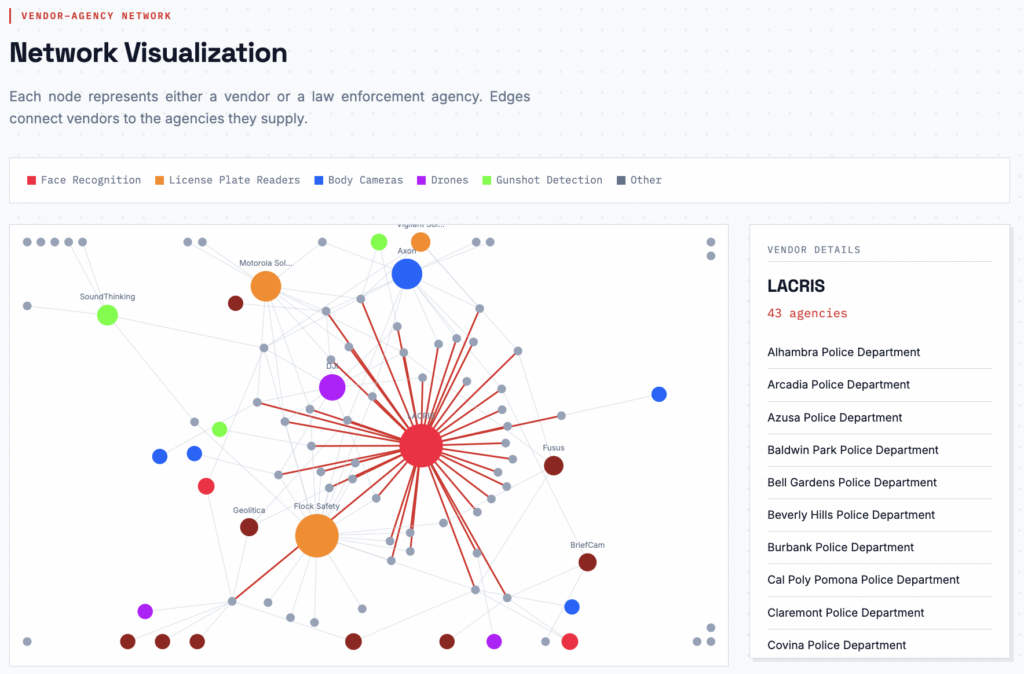
This was a group project for DH 201 with Dr. Cindy Nguyen that I completed with Kyla Yein and Thomas Noya. The project expanded upon other digital projects focused on surveillance technologies, using the Atlas of Surveillance dataset to reveal relationships between the vendors of these technologies and law enforcement agencies in Los Angeles County. Tracing these relationships in multiple ways, the project used GIS mapping, network mapping, and other data visualizations to foreground who profits from the invasive surveillance of daily life. I largely contributed to the project in a supplementary research, technical testing, and project management capacity since it was centered on topics and tools that were more deeply grounded in Kyla’s dissertation research and Thomas’s expertise in programming and GitHub.
References
Bailey, Moya. 2015. “# transform (ing) DH Writing and Research: An Autoethnography of Digital Humanities and Feminist Ethics.” DHQ: Digital Humanities Quarterly 9, no. 2.
Bench, Harmony, and Kate Elswit. 2016. “Mapping Movement on the Move: Dance Touring and Digital Methods.” Theatre Journal 68, no. 4: 575-596.
Bench, Harmony, and Kate Elswit. 2023. “The Body Is Not (Only) a Metaphor: Rethinking Embodiment in DH.” Debates in the Digital Humanities: 93-104.
Bench, Harmony, and Kate Elswit. 2026. “If the Archive Can’t Consent: Reimagining Motion Data and AI Ethics for Dance’s Embodied Histories.” In Cambridge Forum on AI: Culture and Society, vol. 2, p. e1. Cambridge University Press.
Chandler, Tom, Adam Clulow, Chandara Ung, Mike Yeates, Brent McKee, Chulsa Heng, Martin Polkinghorne, Piphal Heng, Bernard Keo, Cindy A. Nguyen, Chloe Floor, and Samuel Horewood. n.d. Virtual Angkor. https://www.virtualangkor.com/.
Cotera, Maria. 2018. “Nuestra Autohistoria: Toward a Chicana Digital Praxis.” American Quarterly. Vol. 70, No. 3: 483-504
Cowan, T. L. 2018. “Run with Whatever You Can Carry”: Cross-Platform Materials and Methods in Performance Studies–Meets–Digital Humanities.: American Quarterly 70, no. 3: 649-655.
D’Ignazio, Catherine, and Lauren F. Klein. 2020. Data Feminism. MIT Press.
Hockey, Susan. 2004. “The History of Humanities Computing.” In A Companion to Digital Humanities, edited cy S. Schreibman, R. Siemens and J. Unsworth. https://doi.org/10.1002/9780470999875.ch1.
Kaplan, Frédéric. 2015. “A Map for Big Data Research in Digital Humanities.” Frontiers in Digital Humanities 2.
Klein, Lauren, Tanvi Sharma, Jay Varner, Shiyao Li, Margy Adams, Nicholas Yang, Dan Jutan, Jianing Fu, Anna Mola, Zhou Fang, Yang Li, and Silas Munro. 2025. Data by Design: An Interactive History of Data Visualization, 1789-1900. public beta.
Lee, Robert, Tristan Ahtone, Margaret Pearce, Kalen Goodluck, Geoff McGhee, Cody Leff, Katherine Lanpher and Taryn Salinas. 2020. “Land Grab Universities.” High Country News. https://www.landgrabu.org/#about.
McKittrick, Katherine. 2015. Sylvia Wynter: On Being Human as Praxis. Duke University Press.
Nelson, Robert K., LaDale Winling, et al. 2023. “Mapping Inequality: Redlining in New Deal America.” Edited by Robert K. Nelson. American Panorama: An Atlas of United States History. https://dsl.richmond.edu/panorama/redlining.
Nguyen, Cindy Anh. 2025. “Critical Readings of a French Colonial Vietnamese Text.” DH+ BH: An Interdisciplinary Collection on Digital Humanities and Book History.
Reynolds, Patrick. 1999. The Oracle of Bacon. https://oracleofbacon.org/.
Risam, Roopika. 2018. “Introduction: The Postcolonial Digital Cultural Record,” New Digital Worlds: Postcolonial Digital Humanities in Theory, Praxis, and Pedagogy, pp. 3-21. Northwestern University Press.
Rusert, Britt, and Whitney Battle-Baptiste. 2018. W. E. B. Du Bois’s Data Portraits: Visualizing Black America. Princeton Architectural Press.
Schweitzer, Marlis. 2015. Transatlantic Broadway: The Infrastructural Politics of Global Performance. Palgrave Macmillan.
Stanger, Arabella. 2021. Dancing on Violent Ground: Utopia as Dispossession in Euro-American Theater Dance. Northwestern University Press.
Tracy, Daniel G., and Elizabeth Massa Hoiem. 2017. “Scaffolding and Play Approaches to Digital Humanities Pedagogy: Assessment and Iteration in Topically-Driven Courses.” Digital Humanities Quarterly 11, no. 4.
Vanhoutte, Edward, Julianne Nyhan, Melissa M. Terras. 2013. Defining Digital Humanities: A Reader. Ashgate Publishing Limited.
Varela, Miguel Escobar. 2021. Theater as Data: Computational Journeys Into Theater Research. University of Michigan Press.
Walsh, Brandon. 2019. “Frustration Is a Feature: Ugly Feelings and the Digital Humanities.” Pedagogy: Critical Approaches to Teaching Literature, Language, Composition, and Culture 19, no. 3: 519-524.
Wilbur, Sarah. 2021. Funding Bodies: Five Decades of Dance Making at the National Endowment for the Arts. Wesleyan University Press.